
On a coral that doesn’t need light to thrive, and how it conquered the seas half a world away from its place of origin—but not without a little help from Big Industry.
Sun on the inside
If you’re familiar with corals—members of the invertebrate phylum Cnidaria, divided into the eight-pointed Octocorallia and the six-pointed Hexacorallia—you’ll know that the majority can photosynthesize. The ocean is home to many fascinating symbioses, and this is one of the most impactful ones of all: tiny photosynthesizing single-celled organisms known as zooxanthellae inhabit most corals’ tissues, working their little dinoflagellate butts off to turn sunlight into energy. They get a home and the coral gets a built-in DoorDash, allowing it to spend less time catching food and more time doing whatever it is corals do when we’re not looking.
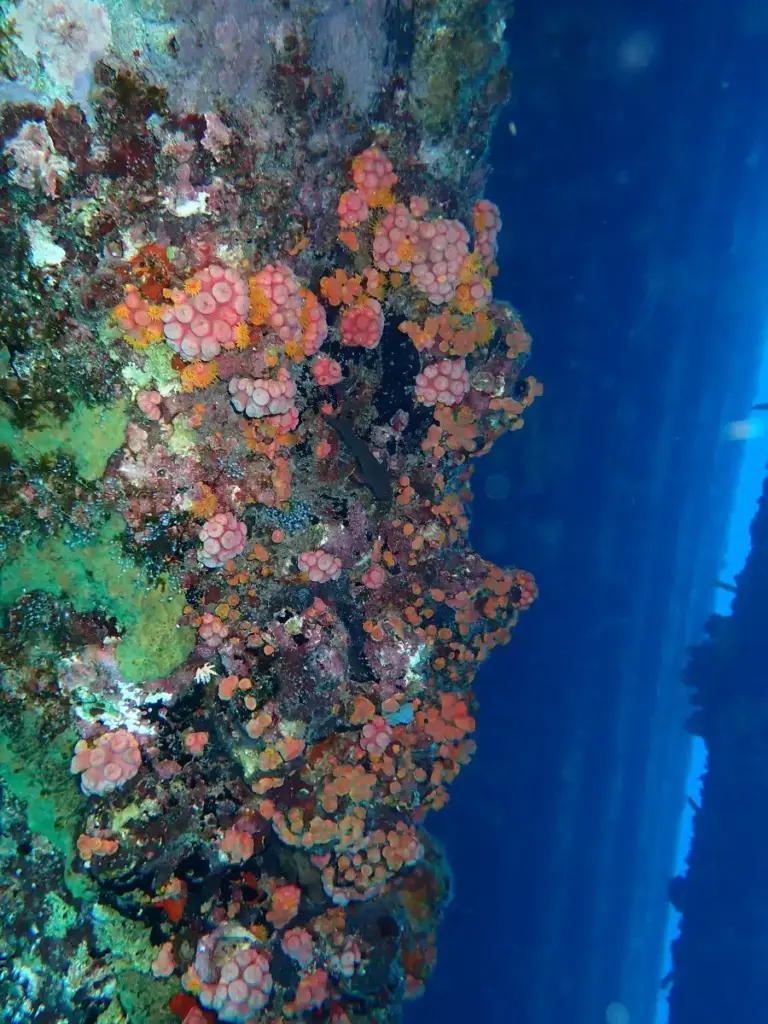
Of course there are exceptions to every rule, and that’s exactly where sun corals of the genus Tubastraea come in. Despite their common name, an obvious reference to their rather sunny appearance, sun corals laugh at the mass of hot plasma at the center of our Solar System—and at photosynthesis. What am I, a plant? No thanks, says Tubastraea, much preferring to catch its own zooplankton using each individual polyp’s multitude of stinging tentacles. It’s not unique in this, but it’s probably the most notorious of the azooxanthellate corals.

Sun coral on the run coral
Photosynthesizing corals make up the majority of the world’s reefs, which means it’s probably a pretty efficient way to survive and thrive for millions of years. But the renegade sun coral does have one very important thing going for it: thanks to its refusal to rely on light for energy, it isn’t confined to the shallows like most of its zooxanthellate cousins. One species, T. micranthus, has been spotted as far down as 183 m (600 ft); the rest occurs at depths of at least 50 m (165 ft), and possibly up to double that. That’s a lot of habitat with little in the way of coral competition!
Luckily, nature has a way of keeping the balance. If a species is successful, a natural predator will inevitably pop up to benefit off that abundance. In the case of the sun coral, one such predator is the golden wentletrap snail (Epidendrium sp.), whose yellow coloration matches its prey perfectly. Its antennae even resemble sun coral tentacles, which undoubtedly helps it to munch polyps without being spotted by critters with a taste for escargot. As such, in Tubastraea’s native stomping grounds—the Indo-Pacific and Eastern Pacific—it’s not considered to be a problematic genus.
This all changes when one rips a creature away from its natural range, and thereby its natural predator (unless that’s accidentally imported too, which happens to be exactly what occurred with the sea walnut in the Black Sea). Observations of sun corals in locations they’re not supposed to be establish clearly that humans did rip this cnidarian from its natural range. Given that the first sightings go back to the 1940s, in Curaçao, the corals have obviously had plenty of time to settle in—and spread. Which is exactly what they did. Two species in particular, T. coccinea and T. tagusensis, seem to be, well, everywhere.
Aside from the Caribbean Sea, scientists have rung alarm bells in Brazil, the Gulf of Mexico, and even the Canary Islands in the Eastern Atlantic. They’re not able to offer much in the way of reassurance, either: sending the sun corals back home isn’t something we appear to be able to do just yet. That’s a problem, because their rising numbers inevitably affect local ecosystems.
A little help from Big Industry
How did sun corals end up halfway across the world? In the majority of such cases of aquatic displacement, the main suspect is the shipping industry. Ballast water, ship hulls covered in encrusting critters: we’ve heard plenty of stories of zebra mussels and European green crabs hitching rides on massive freight vessels and reaching endless new territories totally unprepared for their arrival. Biocides have been used to try and prevent “biofouling” of hulls and ballast water since at least the 1960s, but nature has proved flexible. Besides, though it’s easy to introduce a species, it’s significantly more difficult to unintroduce it once it has gained a foothold.
Sun corals also hopped on the Human Industry Express™, though in a slightly different manner than, say, the zebra mussel. Container ship hulls are mostly smooth and sometimes exposed to strong currents, which means they’re better suited to strong, rigid mussel shells than to squishy corals. But oil platforms and barges? Those are the perfect places to establish Tubastraea Town. There are nooks and crannies galore, plus the structures sit idle for long periods of time. If they do have to be moved to a different location, they’re generally towed much more slowly than the speed a container ship would travel at.
The responsible industries have long been aware of their potential to act as vectors for non-native species, but little has been done so far to control the spread. This is despite the fact that although they’re often technically challenging and expensive, solutions do exist. Freshwater dips have been found to be effective at dealing with sun coral, for example, but unfortunately standardized measures are still few and far between.
“Four lines of evidence support biofouling on oil platforms and/or drill ships as the pathway into Brazil:
(1) all the earliest records of Tubastraea in Brazil are on oil platforms;
Creed et al., 2016
(2) records of oil and gas associated shipping are mirrored by records of invasions into natural communities;
(3) the primary coastal introduction points are always coupled with associated, nearby coastal port facilities, used by oil and gas industry associated shipping, and
(4) the estimated ages of colonies on at least one platform were 15 years older than the arrival of the platform in Brazil.”
Welcome to Tubastraea Town
Prevention truly would have been better than cure. For example, a 2020 study notes that now that sun coral is present, it can continue to expand its new range by cruising along on floating pieces of wood and trash, reproducing abundantly as it goes. This genus doesn’t just multiply sexually by means of internal fertilization, but also asexually through the production of planulae. It does so for more of the year than most other corals, maturing earlier than is usual and releasing particularly sturdy offspring. According to a 2005 study, sun corals can even decide to skedaddle altogether if they encounter adverse conditions—they can send out runners to help find a more favorable spot to settle. As a result, in some areas they now make up over 80% of the benthos.
The problem? Tubastraea Town is unlikely to meet any diversity quota. We often think of corals as stationary beings, but that’s not strictly true: they possess stinging tentacles that they can extend some distance beyond their central polyps. And they do so abundantly, because corals are in fact territorial beings that will sometimes relentlessly bully any competitor growing too close to the colony—even if the other coral was there first. Brazilian Mussismilia corals at Ilha Grande Bay, for example, were shown to experience abundant Tubastraea terrorism. If the sun corals grew at a distance of 5 cm (2″) or less, they would attack and “win” in 100% of cases, never incurring any damage themselves. The native coral goes necrotic, while the invader hoists the flag.
Although not all interactions with local fauna are negative—native Christmas tree worms were found to be using sun corals as their homes in Curaçao, for example—the overall effects of Tubastraea’s arrival on local ecosystems and diversity are unlikely to be positive.
What to do about the sun coral
If you were thinking those wentletrap snails mentioned earlier sound like a good way to get rid of invasive sun corals, please consider the cane toad in Australia, plus dozens of other failed “solutions” along the same lines. As tempting as it sounds to introduce an invader’s natural predator in order to get rid of it, the effects tend to inadvertently ripple far beyond the original problem. In most cases, you’ll now have two invaders on your hands. Will you introduce a third to try and get rid of them? Maybe not.
Given that playing God (or Poseidon?) is what landed us in this mess in the first place, nations along the Western Atlantic are unlikely to be importing snails anytime soon. Instead, the main tool at their disposal is good old elbow grease. Brazil in particular went all-out: it centralized scientific research and public outreach, established a historical records database, monitored sites, trained removal experts, organized eradication actions, and even worked with local communities to turn the coral skeletons into craftwork that could be sold to tourists. It was found that manual removal is indeed effective, and a staggering tonnage of sun coral has already been removed.
Today, various plans are on the table, including one involving deadly hydrogel and underwater drones. But the main obstacles persist: lack of awareness, and lack of cold hard cash. Removing invasive corals isn’t fast, cheap, easy, or even permanent in most cases!
If you want to do your piece and live in the affected area, seek out local organizations like the Brazilian Projeto Coral Vivo—they may be able to train you in sun coral removal and invite you along on their dives. Folks outside Ground Zero can consider supporting global marine NGOs and raise awareness through their own channels.
Oh, and don’t try this at home: improper removal can actually help invasive corals like Tubastraea spread.
Sources & further reading
S. Barbosa, M. D., Okasaki, F. B., de Liz, N. T., Trindade, S. G., Dos Santos, A., De A. Umbuzeiro, G., … & Sabadini, E. (2025). An environmentally friendly bio-based approach to control invasive sun corals (Tubastrea spp.). Scientific Reports, 15(1), 33355.
Bastos, N., Tunala, L. P., & Coutinho, R. (2024). Life history strategy of Tubastraea spp. corals in an upwelling area on the Southwest Atlantic: growth, fecundity, settlement, and recruitment. PeerJ, 12, e17829.
Creed, J. C. (2006). Two invasive alien azooxanthellate corals, Tubastraea coccinea and Tubastraea tagusensis, dominate the native zooxanthellate Mussismilia hispida in Brazil. Coral Reefs, 25(3), 350-350.
Creed, J. C., Fenner, D., Sammarco, P., Cairns, S., Capel, K., Junqueira, A. O., … & Oigman-Pszczol, S. (2017). The invasion of the azooxanthellate coral Tubastraea (Scleractinia: Dendrophylliidae) throughout the world: history, pathways and vectors. Biological Invasions, 19(1), 283-305.
Creed, J. C., Junqueira, A. D. O. R., Fleury, B. G., Mantelatto, M. C., & Oigman-Pszczol, S. S. (2017). The Sun-Coral Project: the first social-environmental initiative to manage the biological invasion of Tubastraea spp. in Brazil. Management of Biological Invasions, 8(2), 181.
Creed, J. C., Casares, F. A., Oigman-Pszczol, S. S., & Masi, B. P. (2021). Multi-site experiments demonstrate that control of invasive corals (Tubastraea spp.) by manual removal is effective. Ocean & Coastal Management, 207, 105616.
Hoeksema, B. W., & ten Hove, H. A. (2017). The invasive sun coral Tubastraea coccinea hosting a native Christmas tree worm at Curaçao, Dutch Caribbean. Marine Biodiversity, 47(1), 59-65.
López, C., Clemente, S., Moreno, S., Ocaña, O., Herrera, R., Moro, L., … & Brito, A. (2019). Invasive Tubastraea spp. and Oculina patagonica and other introduced scleractinians corals in the Santa Cruz de Tenerife (Canary Islands) harbor: Ecology and potential risks. Regional Studies in Marine Science, 29, 100713.
Mehrotra, R., Caballer, M., Kaullysing, D., Jualaong, S., & Hoeksema, B. W. (2024). Parasites or predators? Gastropod ectoparasites and their scleractinian host corals at Koh Tao, Gulf of Thailand, with the description of a new species. Symbiosis, 92(2), 209-230.
Moreira, P. L., Ribeiro, F. V., & Creed, J. C. (2014). Control of invasive marine invertebrates: an experimental evaluation of the use of low salinity for managing pest corals (Tubastraea spp.). Biofouling, 30(5), 639-650.
Tanasovici, R. M., Kitahara, M. V., & Dias, G. M. (2020). Invasive coral Tubastraea spp. population growth in artificial habitats and its consequences to the diversity of benthic organisms. Marine Biology, 167(8), 119.
Vermeij, M. J. (2005). A novel growth strategy allows Tubastrea coccinea to escape small-scale adverse conditions and start over again. Coral Reefs, 24(3), 442-442.